

Disinfection Services for Businesses: What Actually Works vs. Spray and Pray
Not all disinfection services are created equal. Some providers show up with a pump sprayer, mist a few surfaces, and hand you an invoice. That approach might look like action, but it rarely delivers real protection for your employees or customers.
In the DFW area, where summer heat and humidity create ideal conditions for bacteria and mold growth, cutting corners on disinfection is a risk no business can afford. Here is what actually works and what to skip.
Why "Spray and Pray" Falls Short
The spray-and-walk-away method is exactly what it sounds like. A technician applies a disinfectant product to surfaces without proper dwell time, coverage, or preparation. The result is incomplete kill rates and a false sense of security.
Common problems with low-quality disinfection include:
- Disinfectant applied over dirty or greasy surfaces, which blocks effectiveness
- Products wiped off before they reach the required dwell time
- High-touch areas missed entirely
- No verification or documentation of what was treated
- Consumer-grade products used in commercial settings
If your provider cannot explain dwell time or show you an EPA-registered product label, that is a red flag worth taking seriously.
What Effective Commercial Disinfection Actually Looks Like
Professional disinfection follows a specific process. It starts with cleaning, because disinfectants cannot penetrate soil, grease, or organic matter. Surfaces must be cleaned first, then treated with the right product at the right concentration.
A proper disinfection service should include:
- Pre-cleaning of all target surfaces before product application
- EPA List N or equivalent registered disinfectants for the pathogens being targeted
- Appropriate dwell time, typically 1 to 10 minutes depending on the product
- Electrostatic sprayers or ULV foggers for full surface coverage in large spaces
- Focused attention on high-touch zones like door handles, light switches, shared equipment, and restrooms
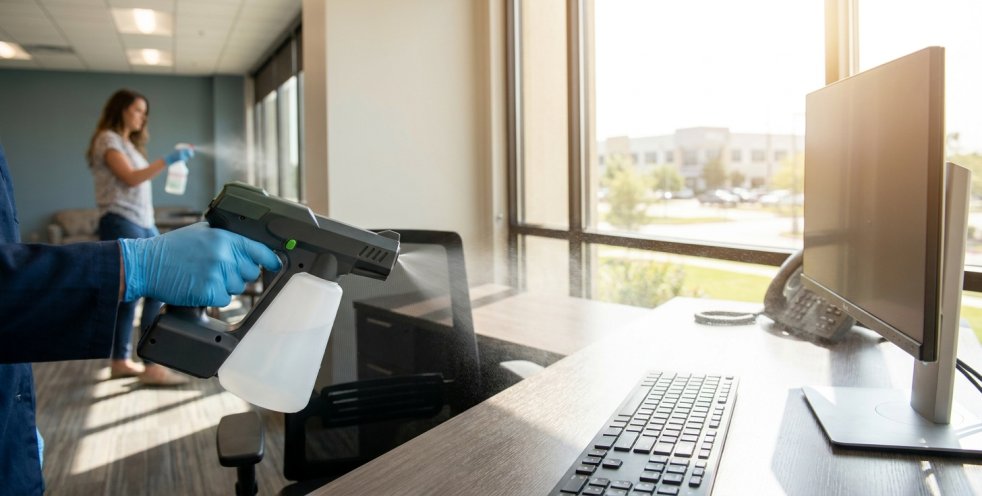
Technology matters here. Electrostatic sprayers wrap product around surfaces, including hard-to-reach edges and undersides, that a standard spray bottle simply cannot reach.
High-Risk Areas DFW Businesses Often Overlook
North Texas businesses deal with specific conditions that increase contamination risk. Summer heat drives people indoors, HVAC systems run constantly, and shared indoor spaces stay packed for months at a time. That creates concentrated zones where pathogens spread fast.
Areas that are frequently not treated include:
- Breakroom appliances, especially coffee makers and microwave handles
- Point-of-sale terminals and shared tablets
- HVAC vents and return air grilles
- Elevator buttons and stairwell railings
- Lobby seating and armrests
If your current provider is not addressing these zones on a documented schedule, your disinfection plan has gaps.
Warning Signs Your Current Disinfection Is Not Working
Sometimes the results speak for themselves. Pay attention to these signals that your facility needs a better approach.
- Employees getting sick more frequently than expected
- Persistent odors in restrooms or breakrooms after cleaning
- No written log of what was disinfected or when
- Your provider cannot name the product being used or its EPA registration number
- Services are rushed and completed unusually fast for the size of your space
These are not minor inconveniences. They are signs that your business, your employees, and your customers are not being properly protected.
One-Time vs. Ongoing Disinfection: Which Do You Need?
One-time disinfection makes sense after a confirmed illness outbreak or following a major event. But for most commercial spaces, a single treatment does not hold. Surfaces are touched and recontaminated within hours.
Ongoing scheduled disinfection is the more practical solution for most DFW businesses. Frequency depends on your foot traffic, industry, and risk level. Medical offices, schools, gyms, and food service facilities typically need more frequent treatment than a small professional office.
A good provider will assess your space and recommend a schedule that fits your operation, not just sell you the most expensive package available.
What to Do Next
If you are not confident in your current disinfection program, or if you have never had a professional service done at all, now is a good time to take action. Start by asking your current provider for product documentation, a service checklist, and a record of treated areas.
System4 DFW provides commercial disinfection services for businesses throughout the Colleyville and DFW area. Our teams use documented protocols, commercial-grade products, and proven application methods so you know the job is actually getting done.
Call (945) 298-0144 today to schedule a walkthrough and get a disinfection plan that works for your facility.

